


 SupplierX
 OrderX
 Xpense
 LogystiX
 ManufeX
 AeonXIQ




Agent Sprawl Is the New Shadow AI: Governing Autonomous Agents Before They Govern You
The Pattern I Keep Seeing
A year ago, the anxious question in my presales conversations was about Shadow AI: employees quietly pasting company data into public chatbots, outside any policy or control. I argued then that Shadow AI is not a policy-violation problem — it is a data-sovereignty problem. You cannot govern data you cannot see.
That problem has not gone away. It has mutated.
Enterprises solved the "employees using ChatGPT" problem by giving people sanctioned tools. But in doing so, they handed those same people the ability to build — low-code agent builders, Bedrock Agents, framework-based agents wired to internal APIs, copilots with tool access. The result is a new and more dangerous version of the old problem: not shadow usage, but shadow agents. Autonomous software, built by scattered teams, that can read data, call APIs, move money, send emails, and take actions — often with no central inventory of what exists, what it can touch, or who owns it.
This is agent sprawl, and it is the new Shadow AI. The difference is that Shadow AI leaked data. Agent sprawl takes actions. A misconfigured chatbot embarrasses you. A misconfigured agent with write access to a production system does something.
This blog is my argument for why agent sprawl is the governance problem of the next 24 months, and a practical framework for getting ahead of it on AWS. It is a thesis piece drawn from patterns I see across engagements — not a single customer case study. Where I cite numbers, they are illustrative of the shape of the problem, not measurements from one deployment.
Why Agent Sprawl Is Worse Than Shadow AI
Shadow AI and agent sprawl rhyme, but the second is a harder problem for four concrete reasons.
1. Agents act, they don't just answer. A Shadow AI incident is usually a disclosure — sensitive text sent somewhere it shouldn't go. An agent incident is an action — a record updated, an email sent to a customer, a refund issued, a ticket closed, an API called. Actions have consequences that a text leak does not, and some actions cannot be undone.
2. Agents have credentials. To be useful, an agent needs access — an API key, an IAM role, a database connection, an OAuth token. Every agent someone builds is a new identity with permissions, often over-provisioned because "make it work" beats "make it least-privilege" under deadline pressure. Shadow AI borrowed a human's session. A shadow agent is its own actor with its own standing access.
3. Agents chain and call each other. One agent calls a tool that is another agent that calls a third. Sprawl compounds: the blast radius of a single over-permissioned agent extends through everything it can invoke. You are no longer governing a list of apps; you are governing a graph whose edges nobody drew.
4. Nobody owns the inventory. With Shadow AI, at least the data-loss-prevention tooling could flag traffic to known chatbot domains. Agents live inside your environment, built on sanctioned platforms, using sanctioned credentials. They look like legitimate workloads because they are. The very sanctioning that solved Shadow AI is what makes agent sprawl invisible.
The uncomfortable summary: enterprises are accumulating a population of autonomous, credentialed, interconnected actors faster than they are building any capability to see, govern, or revoke them.
The Four Questions That Expose Your Sprawl
When I sit with a technology leader, I don't open with architecture. I ask four questions. The discomfort they produce is the diagnostic.
- How many agents are running in your environment right now? Not "how many did we sanction" — how many exist, including the ones a product team stood up last sprint. Most leaders cannot answer within an order of magnitude.
- For each agent, what can it actually do? Not what it was designed to do — what its credentials permit it to do. An agent built to "summarise support tickets" whose role has broad read/write access can do far more than summarise.
- If an agent misbehaves at 2 a.m., who gets paged, and can they kill it? Ownership and a kill switch. Sprawl means agents with no clear owner and no fast way to revoke access.
- What did your agents do yesterday? An auditable log of actions taken — not model outputs, but actions: what was called, what was changed, on whose authority. Most enterprises log the chat, not the consequences.
If those four questions are hard to answer, you don't have an agent strategy. You have agent sprawl.
The Governance Framework: Inventory, Identity, Guardrails, Observability
Governing agents is not about slowing teams down. It is about making the safe path the easy path, so teams build fast and governed. The framework I recommend has four layers, and it maps cleanly to AWS primitives.
Layer 1: A Central Agent Registry (You Can't Govern What You Can't See)
The first move is an inventory. Every agent — regardless of who built it or what framework it uses — must register before it gets production credentials. A registry entry records: owner, purpose, the tools/APIs it may call, the data domains it touches, its IAM role, and a data-sensitivity classification.
On AWS this is a lightweight service, not a heavyweight bureaucracy: a DynamoDB table as the registry, an API to register/update, and — critically — a policy gate that refuses to issue an agent its production IAM role unless it has a valid registry entry. The registry stops being paperwork the moment it becomes the only path to credentials.
Layer 2: Identity and Least-Privilege (Every Agent Is a Governed Actor)
Each agent gets its own scoped identity — never a shared "app" role, never a human's credentials. On AWS, that means a dedicated IAM role per agent, scoped to exactly the actions the registry says it needs, with permission boundaries that cap what any agent role can be granted even if someone tries to widen it later.
The principle: an agent's blast radius should equal its job description and nothing more. A ticket-summarising agent gets read access to tickets — not write access, not access to billing, not access to customer PII it doesn't need.
Layer 3: Runtime Guardrails (Bound What Agents Can Say and Do)
Two kinds of guardrails, because agents both generate content and take actions:
- Content guardrails (Amazon Bedrock Guardrails) bound what an agent can say — blocking PII leakage, denied topics, and unsafe outputs.
- Action guardrails are the agentic-era addition: high-consequence actions (issuing a refund, deleting a record, emailing a customer, moving money) must pass a policy check and, above a threshold, require human approval. An agent can draft the refund; a human — or a strict policy — authorises it.
The design rule: the higher the consequence and the lower the reversibility of an action, the more confirmation it requires. Read is free. Reversible writes are gated. Irreversible actions need a human in the loop.
Layer 4: Observability of Actions (Log Consequences, Not Just Conversations)
Most teams log what the agent said. Governance requires logging what the agent did: every tool call, every API invocation, every state change, attributed to the agent's identity, streamed to a central, tamper-resistant store. On AWS, that is CloudTrail for API-level actions plus a structured action log (the agent emitting a signed record of each tool call to CloudWatch/S3), with anomaly alerting when an agent's behaviour deviates from its registered purpose.
This is the layer that answers question four — "what did your agents do yesterday?" — and it is the one most often skipped, because it feels like overhead until the first incident.
Reference Architecture on AWS
Here is the reference pattern I walk leaders through. It is deliberately built from managed services so a small platform team can operate it.
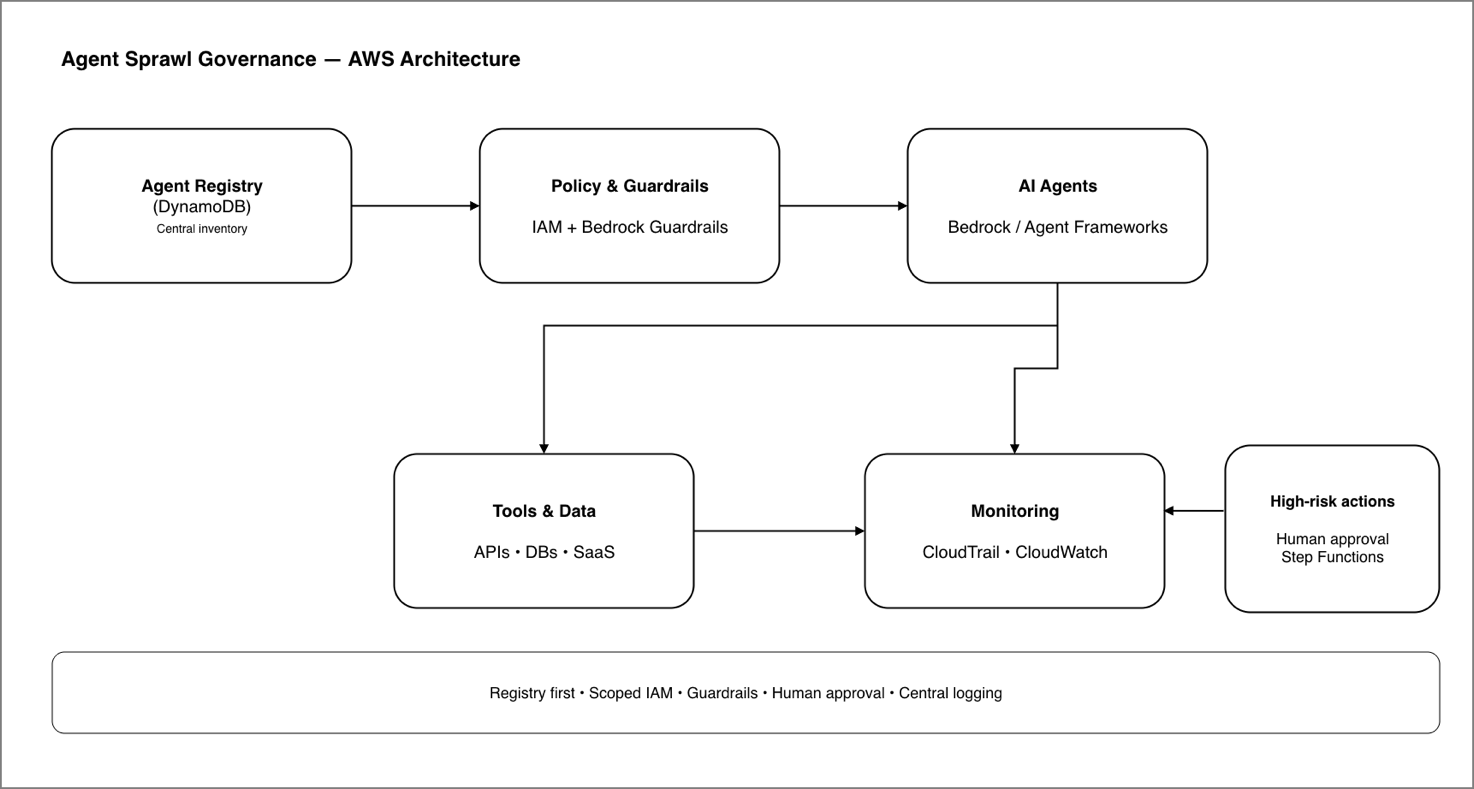
The Policy Gate: No Registry Entry, No Credentials
The single most effective control is making the registry the only path to a production identity. This is a policy check in your deployment pipeline: before an agent's IAM role is attached, verify a valid, current registry entry exists.
# Deployment gate: refuse to provision an agent role without a registry entry
import boto3

ddb = boto3.resource("dynamodb", region_name="ap-south-1")
registry = ddb.Table("agent-registry")

REQUIRED_FIELDS = ["owner", "purpose", "allowed_tools", "data_classification", "iam_role_arn"]

def validate_agent_registration(agent_id: str) -> None:
    """Called by the CI/CD deploy step before an agent role is attached.
    Raises (fails the deploy) if the agent is not properly registered."""
    resp = registry.get_item(Key={"agent_id": agent_id})
    entry = resp.get("Item")

    if not entry:
        raise PermissionError(
            f"Agent '{agent_id}' has no registry entry. "
            f"Register it (owner, purpose, tools, data class) before deployment."
        )

    missing = [f for f in REQUIRED_FIELDS if not entry.get(f)]
    if missing:
        raise PermissionError(f"Agent '{agent_id}' registry entry missing: {missing}")

    if entry.get("status") != "approved":
        raise PermissionError(f"Agent '{agent_id}' is registered but not approved.")

    # Optional: enforce periodic re-attestation so stale agents lose access
    # if entry["last_attested"] older than 90 days -> raise
The Action Guardrail: Gate High-Consequence Tool Calls
# Wrapper every agent tool call passes through before execution
ACTION_RISK = {
    "read_ticket":      "low",       # reversible, no side effect
    "update_ticket":    "medium",    # reversible write
    "send_customer_email": "high",   # externally visible, hard to unsend
    "issue_refund":     "critical",  # moves money, needs human approval
    "delete_record":    "critical",  # irreversible
}

def authorize_action(agent_id: str, action: str, params: dict) -> str:
    """Return 'allow', 'deny', or 'require_approval' before a tool executes."""
    risk = ACTION_RISK.get(action, "high")  # default deny-ish for unknown actions

    if risk == "low":
        return "allow"
    if risk == "medium":
        # allowed, but logged with full context for the audit trail
        log_action(agent_id, action, params, decision="allow")
        return "allow"
    if risk in ("high", "critical"):
        # route to a human-approval step (e.g. Step Functions approval task)
        log_action(agent_id, action, params, decision="require_approval")
        return "require_approval"
    return "deny"
Illustrative Signals: What Sprawl Looks Like by the Numbers
These figures are illustrative — the shape of what I see across engagements, not measurements from one company. The point is not the exact number; it is the gap between what leaders assume and what is actually running.
| Signal | What leaders typically assume | What an inventory typically reveals |
|---|---|---|
| Number of agents in the environment | "A handful, the ones we approved" | Often several multiples more once you count team-built ones |
| Agents with over-scoped credentials | "Ours are least-privilege" | A meaningful share have far broader access than their job needs |
| Agents with a clear, current owner | "Of course everything has an owner" | A surprising fraction are orphaned after a project or a team change |
| Agents with an action audit trail | "We log everything" | Most log the conversation, not the consequential actions |
The value of the registry-first approach is that it converts every one of these unknowns into a known — and it does so before the incident that would otherwise reveal them.
A Presales Perspective: Governance Is What Lets You Say Yes
In my presales engagements, the reflex reaction to agent-governance conversations is that governance slows innovation. I argue the opposite, and it is the argument that lands.
The enterprises stuck at "one or two agents in production" are usually the ones without a governance model — because every new agent triggers a fresh, exhausting security review from scratch. There is no reusable path, so each one is a negotiation. Governance, done as a platform, is what makes the tenth agent as easy to ship as the first: register, get a scoped identity, inherit the guardrails, appear in the audit trail. The safe path becomes the fast path.
The conversation that shifts a room is reframing the four diagnostic questions from an audit into an enabler. "You can't answer how many agents you have" is not a scolding — it is the moment a leader realises that a registry isn't red tape, it's the thing that lets them green-light the next twenty agents without fear. Governance is not the brake. It is the thing that lets you take your foot off the brake.
Lessons for Technology Leaders
- Agent sprawl is the sequel to Shadow AI, and it's worse — Shadow AI leaked data; sprawl takes actions with real-world consequences using standing credentials. Treat it with more urgency than you treated Shadow AI, not less.
- You cannot govern what you cannot see — so make the registry the only door — An inventory that teams can bypass is theatre. Make a registry entry the mandatory precondition for production credentials, enforced in the pipeline. That single control does more than any policy document.
- Every agent is an identity — give it a scoped one — No shared roles, no borrowed human credentials. One agent, one least-privilege role, capped by a permission boundary. An agent's blast radius should equal its job and nothing more.
- Gate actions by consequence and reversibility, not by whether they're "AI" — Read is free, reversible writes are logged, irreversible or externally-visible actions need a human. This is the control that separates a helpful agent from an autonomous liability.
- Log consequences, not conversations — What the agent said is interesting; what it did is what you'll be asked about after an incident. Build the action audit trail before you need it, because you will need it.
Conclusion
We spent 2024 and 2025 worrying about employees pasting secrets into chatbots. We were right to worry, and many enterprises built sensible controls. But in solving Shadow AI, we handed those same employees the power to build autonomous agents — and we are now accumulating credentialed, interconnected, action-taking software faster than we can see or govern it.
Agent sprawl is the new Shadow AI. It is harder because agents act rather than answer, hold their own credentials, chain into graphs, and hide inside sanctioned infrastructure. The good news is that the controls are well understood and buildable today on AWS: a registry that gates credentials, a least-privilege identity per agent, guardrails that bound both words and actions, and observability that logs consequences.
The enterprises that get ahead of this will not be the ones that ban agents — they'll be the ones that make the governed path the fastest path, so their teams build boldly because the guardrails are there. The ones that don't will spend the next two years discovering, one incident at a time, exactly how many agents they had and exactly what those agents could do.
You can build that inventory now, on your terms. Or you can build it later, during an incident, on the worst possible terms. That choice is the whole thesis.
About the Author
Rajat Jindal is VP – Presales at AeonX Digital Technology Limited, where he architects winning cloud strategies for enterprise customers and translates modernization into measurable business value. He is a strong advocate of AWS, committed to sharing thought leadership that helps technology leaders make faster, better-informed decisions.


